Introduction
Air fryer technology has fundamentally changed how many people approach everyday cooking. What started as a niche kitchen gadget has become a mainstream appliance found in countless households. The appeal is straightforward: faster cooking times, reduced oil consumption, and the ability to achieve crispy textures without traditional deep frying methods.
The market has evolved considerably, and today’s air fryers come in various sizes and configurations. For families or anyone who regularly cooks for groups, the question of capacity becomes increasingly important. Standard air fryer baskets often feel limiting when you’re trying to prepare meals for more than a few people, which is where larger-capacity models enter the conversation.
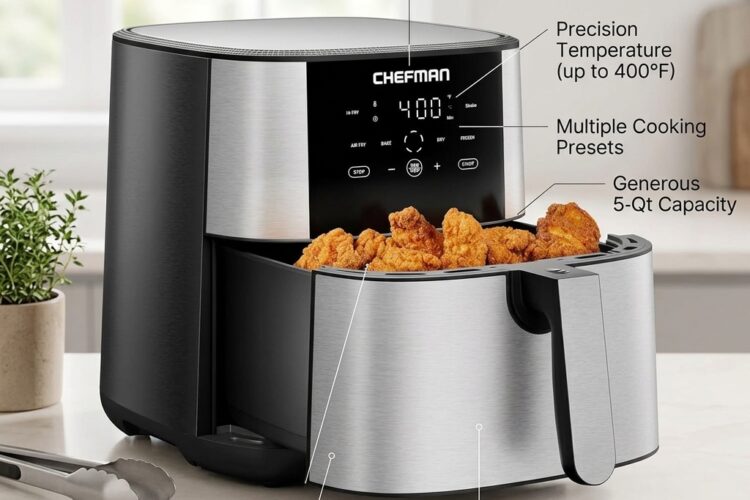
The Chefman 8 Qt TurboFry represents one approach to solving the capacity problem. Understanding what this product offers—and equally important, what it doesn’t—requires looking beyond marketing language to examine the actual features, functionality, and practical considerations involved in large-capacity air fryer cooking.
Understanding Air Fryer Capacity and What 8 Quarts Actually Means
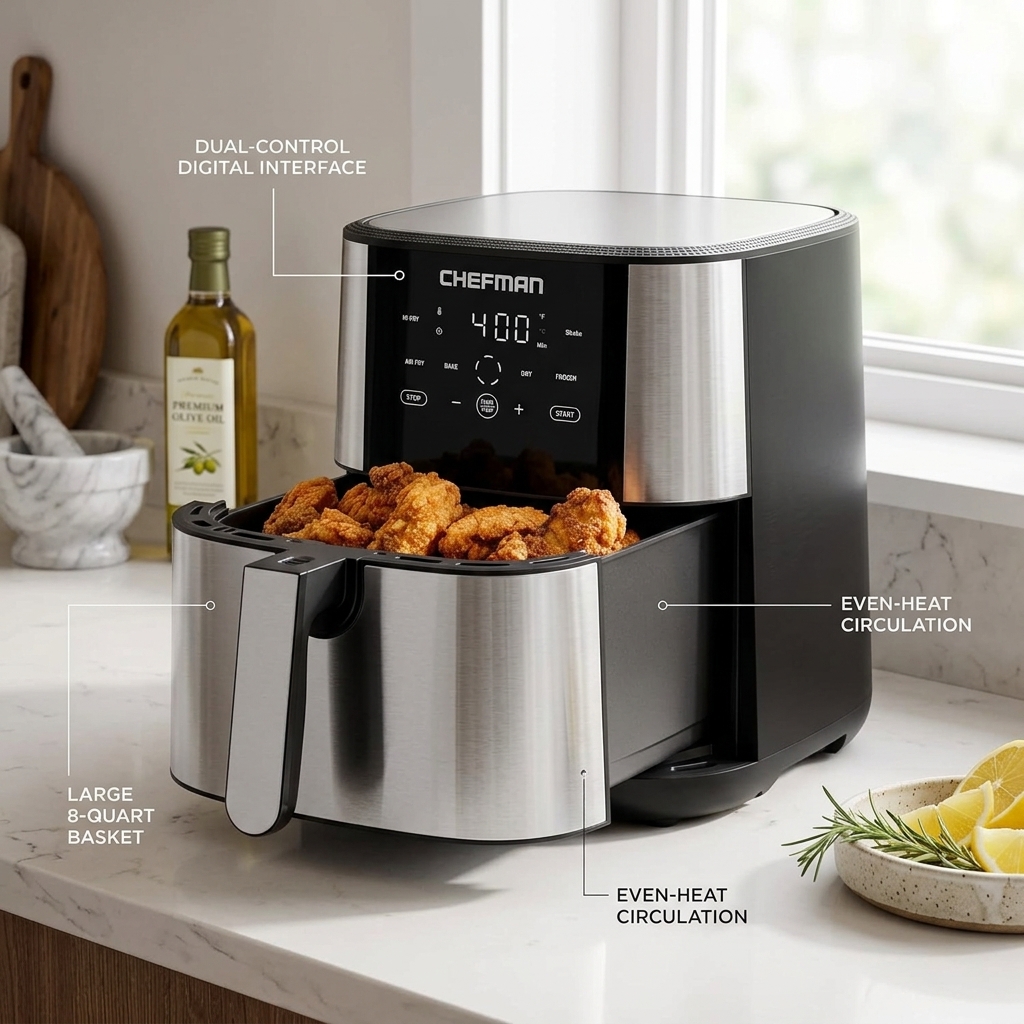
Before diving into the specifics of any particular model, it’s worth understanding what capacity actually represents in the air fryer world. When manufacturers specify an 8-quart basket, they’re referring to the interior volume available for food. This doesn’t mean you can fill it completely with food; air circulation is essential to how these appliances function.
An 8-quart capacity represents a significant step up from standard models, which typically range from 4 to 6 quarts. This extra space translates to practical benefits for certain situations: preparing multiple chicken breasts simultaneously, cooking larger batches of frozen foods, or preparing components of a meal at the same time rather than sequentially.
However, it’s crucial to approach the capacity figure realistically. The actual amount of food you can cook at once depends on several factors: the shape and size of individual pieces, how densely you can arrange them without blocking air circulation, and the specific recipe or cooking method you’re using. A basket might technically hold eight quarts in volume, but optimal cooking performance requires leaving enough space for hot air to circulate properly around each piece of food.
Key Features and Technical Specifications
The TurboFry Technology and Temperature Range
The 450°F Hi-Fry option represents a notable specification within this model’s design. Most standard air fryers operate with maximum temperatures in the 390-400°F range. The additional temperature capacity allows for certain applications that benefit from higher heat, particularly when seeking intense surface crisping or when working with thicker cuts of protein that require both speed and surface browning.
Higher temperature capability doesn’t universally make a product “better”—it simply expands the range of techniques available to the user. Some foods cook more effectively at lower temperatures with longer cooking times, while others benefit from the rapid Maillard reaction that occurs at higher temperatures.
Multifunctional Cooking Methods
The model’s designation as “4-in-1” reflects its ability to perform different cooking functions beyond the standard air frying method:
Air frying remains the primary function, using rapid hot air circulation to cook food with minimal added fat. This is the core capability that appeals to most users who choose this category of appliance.
Baking functionality allows the unit to operate more like a small convection oven, useful for items like pastries, breads, or dishes that require gentler, more even heat distribution than traditional air frying provides.
Dehydrating expands the appliance’s utility significantly. This function removes moisture from food at lower temperatures over extended periods. People use dehydrating capabilities for making dried fruits and vegetables, jerky preparation, or creating chips from various ingredients.
Handling frozen foods is less a separate cooking method and more an acknowledgment that this device can cook frozen items directly without thawing. Many air fryers handle frozen foods well, but having this explicitly included in the marketing reflects real-world usage patterns.
Basket and Surface Considerations
The nonstick dishwasher-safe basket is a practical feature that affects daily usability more than cooking performance. A nonstick coating reduces the likelihood of food sticking during cooking and makes cleanup substantially easier—significant factors when using an appliance multiple times per week.
Dishwasher safety is worth noting specifically. Not all air fryer baskets are designed for dishwasher use; some manufacturers recommend hand washing only. Having a basket that tolerates dishwasher cleaning reduces the friction associated with regular maintenance, which influences how frequently people actually use their appliance.
The stainless steel exterior represents a material choice that affects aesthetics and durability. Stainless steel resists fingerprints better than some alternatives and generally maintains appearance through repeated cleaning and use over time.
Practical Applications and Cooking Possibilities
Weeknight Dinner Preparation
The expanded capacity begins to demonstrate its value in practical meal preparation scenarios. Consider preparing a weeknight dinner for a family of four or five. Rather than cooking items in batches, you might prepare an entire meal’s components simultaneously—protein on one area of the basket, vegetables in another—then plate directly from the appliance.
This capability extends to meal prep situations, where someone might prepare components in bulk for the week ahead. The larger basket means fewer separate cooking cycles, which translates to faster overall preparation time.
Entertaining and Batch Cooking
For people who regularly cook for gatherings or have larger households, the capacity advantage becomes more pronounced. Preparing appetizers for a gathering, batch-cooking a large quantity of frozen dumplings, or preparing crispy vegetables as a side for a sit-down dinner all benefit from the additional space.
Batch cooking for freezing is another practical application. Someone might cook a large quantity of breaded items, dehydrated snacks, or other prepared foods in a single session, then freeze portions for future use.
Exploring Different Cooking Techniques
The dehydrating function opens particular possibilities for home cooks interested in food preservation and experimentation. Making dried herbs from a garden, creating homemade dried fruit snacks, or preparing vegetable chips from surplus produce represents applications that go beyond what a standard air fryer alone can accomplish.
The baking function similarly extends the appliance’s range. Items like small loaves of bread, sheet pan desserts, or roasted vegetables might cook more evenly using the baking mode than traditional air frying settings.
Working with Different Food Categories
Proteins: Chicken breasts, thighs, pork chops, or fish fillets cook effectively. The larger capacity means preparing enough protein for multiple meals or servings in one session.
Vegetables: Root vegetables, leafy greens, mushrooms, and other vegetables crisp up well. The expanded space allows roasting multiple vegetable types simultaneously for a composed side dish.
Frozen foods: From frozen french fries to frozen chicken nuggets to frozen battered fish, the appliance handles these directly. Frozen foods benefit particularly from increased air circulation space, which allows them to crisp effectively without crowding.
Baked goods: Using the baking mode, items from small cakes to quick breads to dinner rolls can cook with results comparable to conventional oven baking, though with faster cooking times.
Dehydrated items: Thin slices of fruit, herbs, or vegetables dehydrate at lower temperatures over extended periods.
Who This Appliance May Be Suitable For
Larger Households
Families with four or more people cooking at the same table benefit most from the capacity advantage. Rather than managing multiple cooking batches, larger quantities cook simultaneously, which both saves time and reduces the overall energy consumption compared to cooking items sequentially.
People Who Entertain Regularly
Those who frequently prepare food for gatherings, whether casual family dinners or more formal entertaining, find the expanded capacity useful. The ability to prepare significant quantities of appetizers, side dishes, or components of the main course reduces the coordination complexity of timing multiple dishes.
Individuals Interested in Food Preservation
Home cooks interested in dehydrating their own snacks, preserving seasonal produce, or creating preserved goods benefit from the dehydrating functionality. The 8-quart size allows larger batches of items like dried fruits or vegetable chips than smaller models.
People with Limited Oven Access
In situations where oven space is limited—whether due to kitchen layout, multiple people cooking simultaneously, or simply preferring not to heat up a full-size oven—an air fryer with baking capabilities offers an alternative for items that traditionally cook in an oven.
Meal Prep Enthusiasts
People who dedicate time to batch cooking and preparing components in advance find larger-capacity appliances reduce the number of separate cooking sessions required. This efficiency appeals particularly to those following specific dietary approaches that involve preparing multiple components.
Households Cooking Multiple Dietary Requirements
When different household members follow different diets—some cooking gluten-free items, others non-vegetarian, etc.—the larger basket sometimes allows cooking multiple items simultaneously that might otherwise require sequential batches.
Important Considerations and Realistic Expectations
Space Requirements
An 8-quart air fryer occupies more counter space than smaller models. Before considering this appliance, measuring available counter space and considering kitchen workflow is practical and important. Some people address this by designating permanent counter space for the appliance; others rotate it from storage, which adds friction to actual usage.
The unit also requires clearance around it for proper ventilation. Placing it directly against a wall or under cabinets can impede airflow and affect cooking performance. Understanding your kitchen layout before purchasing prevents frustration later.
Learning Curve and Temperature Management
Using a larger-capacity appliance doesn’t automatically mean adding more food proportionally to standard recipes. The relationship between basket size and cooking time isn’t always linear. Filling a larger basket more densely can affect air circulation and cooking evenness compared to a less-full smaller basket.
Learning how to optimally use the 8-quart capacity involves some experimentation. What works perfectly in a 4-quart model might require time and temperature adjustments in an 8-quart unit. This isn’t a fundamental flaw—it’s simply a characteristic of the appliance that users should anticipate.
Maintenance and Cleaning
While dishwasher-safe baskets simplify cleanup, the larger size means more surface area to clean. Some people find this trivial; others find it noteworthy. Understanding your personal threshold for appliance maintenance affects how enjoyable you’ll find using the device regularly.
Noise and Operating Characteristics
Larger appliances with more powerful heating elements and fans tend to operate differently than smaller units. They may produce different noise levels during operation. If the appliance will be located in a space where noise matters—near a dining area, in a small kitchen—this aspect deserves consideration.
Recovery Time Between Batches
Even with larger capacity, if you do need to cook items sequentially, the appliance requires the basket to cool or be removed before adding new food. This doesn’t dramatically extend timing, but it’s worth acknowledging that batch cooking still involves more effort than single-batch cooking.
General Comparison: Large-Capacity Air Fryers in Context
Large-capacity air fryers sit in an interesting position within the broader landscape of cooking appliances. Understanding how they compare to related categories helps clarify when this type of product makes sense versus alternatives.
Versus Standard Air Fryers
Standard air fryers (typically 4-6 quarts) cost less, occupy less space, and cook faster due to more compact interior dimensions. They’re excellent for individuals or couples and handle most everyday cooking needs. The trade-off in choosing a larger model is accepting higher cost and space consumption in exchange for reduced cooking cycles when preparing for groups.
Versus Toaster Ovens
Toaster ovens and air fryers often compete in kitchens. Toaster ovens typically offer a larger cooking surface and better visibility into the cooking process through a glass door. Air fryers generally cook faster and with less oil. Neither category universally outperforms the other—they excel in different applications.
An 8-quart air fryer might actually cook more total food than a standard toaster oven in equivalent time, despite the toaster oven’s larger visual interior, because of how efficiently air circulation cooks food compared to radiant heating.
Versus Convection Ovens
Full-size convection ovens provide significantly more capacity and versatility. However, they consume more energy, take longer to preheat, and occupy considerable counter or built-in space. For specific applications, a large air fryer provides faster, more focused cooking with less energy consumption.
Versus Batch Cooking on Stovetop or Standard Oven
When the alternative is cooking items sequentially using conventional methods, a large-capacity air fryer potentially reduces total time investment. If you currently cook in batches using your stovetop or conventional oven, the capacity advantage of an 8-quart model becomes more tangible.
Frequently Asked Questions
How much electricity does an 8-quart air fryer consume?
Air fryers generally consume between 1400-2200 watts during operation, depending on model and heating intensity. When compared to a conventional oven, which typically uses 3000-5000 watts, air fryers are relatively efficient. The actual electricity cost depends on local rates and usage frequency. For occasional use, the difference is negligible; for daily use, it becomes more noticeable.
Can you cook multiple foods simultaneously without flavors mixing?
The short answer: with proper arrangement and attention, yes. Air circulation within the basket means flavors don’t readily transfer from one food to another, especially if items are separated. Strong-flavored foods (like fish) placed far from milder items won’t significantly impact taste. That said, some subtler flavor transfer is possible, particularly with aromatics.
How long does dehydrating actually take?
Dehydrating times vary dramatically based on what you’re dehydrating, how thickly you slice items, and ambient humidity. Thin fruit slices might dehydrate in 4-8 hours, while thicker vegetables could require 12-24 hours. These extended times mean dehydrating usually happens as a background process rather than primary cooking activity.
Does the temperature range up to 450°F actually matter for most cooking?
For most everyday applications, higher temperatures matter less than the ability to achieve proper cooking and browning. That said, certain applications benefit: quick crisping of already-cooked items, achieving particular browning effects on proteins, or working with foods that specifically benefit from high-heat cooking. It’s an advantage but not a necessity for basic cooking.
What’s the actual usable capacity versus the stated 8 quarts?
Practically, you’ll use somewhere between 60-75% of the stated capacity to maintain proper air circulation. This means approximately 5-6 quarts of actual food capacity for optimal cooking. This isn’t a limitation unique to this model—it’s characteristic of how air fryers function.
Is the nonstick coating durable?
Nonstick coatings generally last several years with normal use. Avoiding metal utensils, not using abrasive scouring methods, and hand drying rather than machine drying extend coating lifespan. Most users report the coating remaining effective for 3-5+ years with normal use.
Can you use the baking function for anything you’d cook in a conventional oven?
Most items work well, with the primary difference being reduced cooking time due to the more efficient heat transfer from convection. Very large items that won’t fit within the basket dimensions are the main limitation. Otherwise, temperature and time adjustments allow most conventional oven recipes to work.
Does the 450°F maximum temperature affect any specific cooking applications?
The higher temperature ceiling is most relevant for: quickly crisping already-cooked items, working with certain cuts of meat where surface browning is the priority, or attempting cooking techniques that specifically require very high heat. For standard applications, temperatures below 400°F handle most cooking effectively.
Conclusion
The Chefman 8 Qt TurboFry represents a particular solution to specific cooking challenges: situations where standard air fryer capacity feels limiting, where batch cooking currently dominates your kitchen routine, or where the additional functions (particularly dehydrating) align with your cooking interests.
The expanded capacity genuinely addresses real constraints for larger households, frequent entertainers, and batch-cooking enthusiasts. The 450°F maximum temperature and multifunctional capabilities expand what’s possible beyond basic air frying. The larger size does require adequate counter space and involves accepting trade-offs in terms of storage and appliance footprint.
Whether this particular model makes sense depends on aligning its strengths—large capacity, multiple cooking functions, higher temperature range—with your actual cooking needs and kitchen situation. For some households, it’s an ideal addition that reduces cooking time and increases versatility. For others, a smaller model would serve equally well while taking up less space.