Introduction
The kitchen landscape has shifted noticeably over the past few years. More people are working from home, apartment living has become increasingly popular, and the desire for healthier cooking methods continues to grow. Yet for many households, counter space remains a precious commodity. This creates an interesting challenge for anyone considering an air fryer—a kitchen appliance that’s gained considerable attention for its versatility and efficiency, but often comes with a footprint that doesn’t work for everyone.
Enter compact air fryers designed with spatial constraints in mind. These units attempt to bridge the gap between functionality and practicality, offering cooking capabilities without demanding an entire section of your counter. Understanding whether such an appliance makes sense for your situation requires looking beyond marketing claims and examining what these devices actually do, how they perform, and whether they genuinely fit your cooking patterns and kitchen layout.
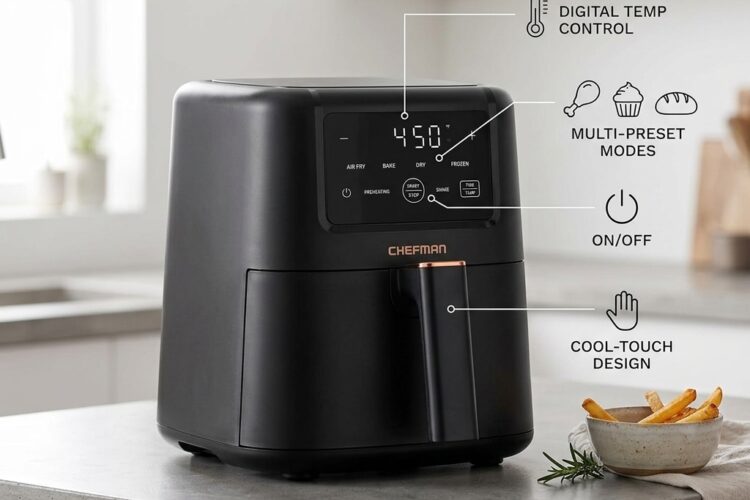
This guide explores the practical considerations around compact air fryers, using the Chefman Compact Air Fryer 3.5 QT as a reference point to discuss how these appliances work, what they’re actually capable of, and how to determine if this category of cooking equipment aligns with your needs.
Understanding Modern Air Frying Technology
Before examining a specific model, it helps to understand what air frying actually is—and more importantly, what it isn’t. This clarity prevents misunderstandings about capabilities and performance expectations.
Air frying relies on rapid air circulation technology. A heating element reaches a specific temperature (in this case, up to 450°F), and a powerful fan circulates that hot air around food at high speed. This rapid circulation creates a convection effect that cooks food from multiple angles simultaneously. The result is a browning and crisping process that occurs through the Maillard reaction—the same chemical process that happens when you pan-sear or deep-fry food.
The key difference compared to traditional deep frying is the amount of oil involved. While traditional frying requires submerging food in several inches of oil, air frying typically requires little to no added oil, or at most a light coating. This reduction in oil changes the nutritional profile of cooked foods without necessarily altering the texture or taste that people often find appealing about fried foods.
Compact air fryers operate on the same principle as their larger counterparts. The main trade-offs involve capacity and, sometimes, the power and consistency of the heating system. Understanding these variables helps set realistic expectations about cooking speed, batch sizes, and performance.
Key Features of the Chefman Compact Air Fryer 3.5 QT
The Chefman model emphasizes a particular niche: fitting into smaller living spaces without completely sacrificing functionality. Let’s examine the specific features and what they mean in practical terms.
Capacity and Dimensions
The 3.5-quart capacity sits in an interesting middle ground. It’s substantially larger than the tiniest personal air fryers (which often hold around 2 quarts), yet notably smaller than full-size models that can reach 6 or 7 quarts. This size generally accommodates cooking for two to four people in a single batch, depending on what you’re preparing.
The “slim design” designation reflects a narrower footprint than traditional air fryers, which typically have a more squared-off appearance. This narrower profile allows the unit to fit in tighter spaces—the corner of a counter, between a microwave and the wall, or in kitchen configurations where a standard rectangular appliance simply won’t work.
However, it’s important to verify actual dimensions against your available space before purchasing. Slim doesn’t necessarily mean minimal depth, and the height of the basket when assembled may surprise you if you haven’t considered vertical clearance.
Multi-Function Cooking Capabilities
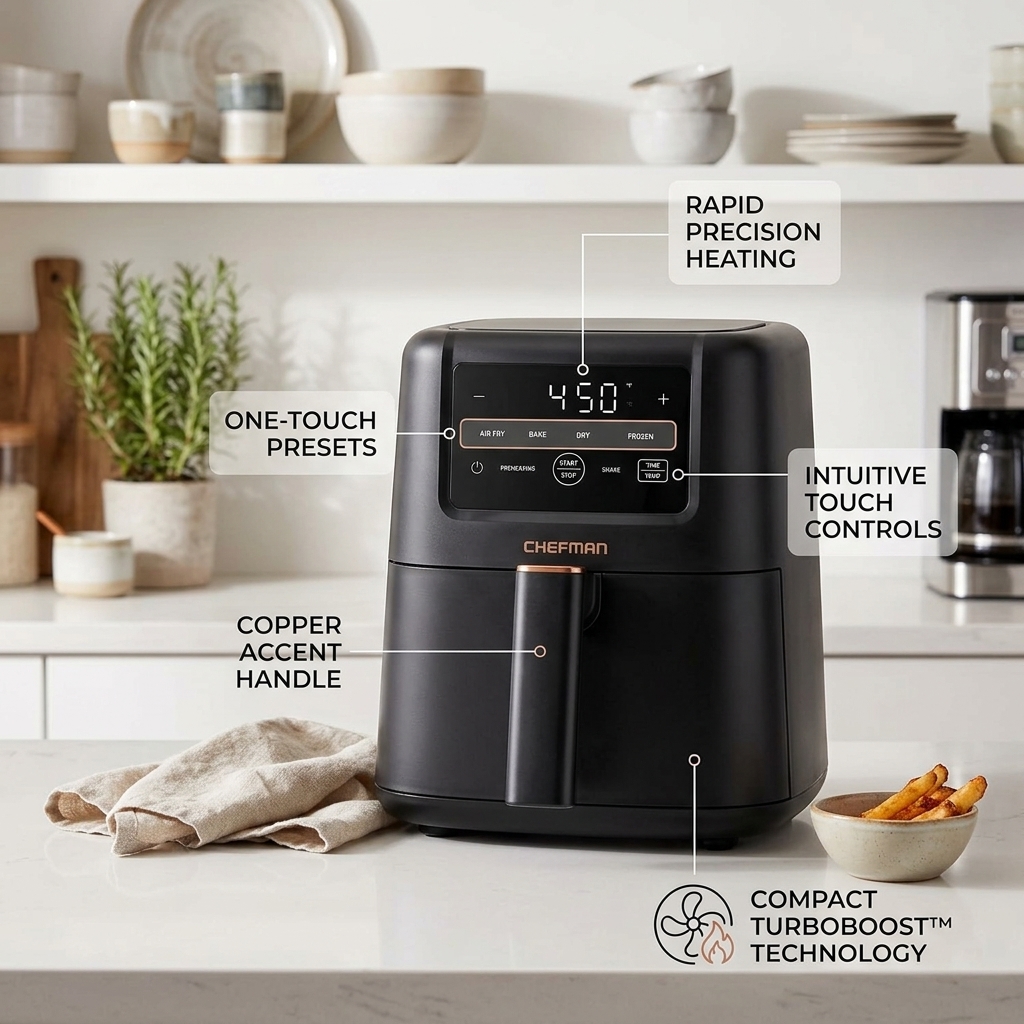
The “4-in-1” designation indicates the unit can perform four distinct cooking functions: air frying, baking, dehydrating, and cooking frozen foods. These aren’t four completely separate cooking methods—they’re variations on the core convection cooking principle, with adjustments to temperature, timing, and sometimes air circulation patterns.
Air frying is the primary function and what most users will rely on. This creates crispy exteriors on foods using rapid hot air circulation with minimal oil.
Baking uses similar convection principles but typically maintains more consistent, moderate temperatures and allows for longer cooking times. Items like small pastries, reheated baked goods, or individual-sized pizzas can work in a compact air fryer.
Dehydrating involves running the appliance at low temperatures for extended periods. This removes moisture from foods like fruits, vegetables, or herbs without cooking them. This function requires proper ventilation and understanding of food safety principles related to dehydration.
Frozen food cooking isn’t necessarily a unique function but rather a preset that adjusts time and temperature for frozen items. Most air fryers can handle frozen foods, though the compact size means batch quantities will be smaller.
Temperature Range and Control
A maximum temperature of 450°F covers most practical cooking applications. This is sufficient for crisping, browning, and cooking through most foods you’d typically prepare. For context, conventional ovens often go higher, reaching 500°F or beyond, but 450°F is adequate for air fryer cooking where the proximity to the heat source and active air circulation compensate for the lower maximum temperature.
The ability to adjust temperature precisely allows for cooking at lower temperatures when appropriate—such as gentle reheating or dehydration tasks.
Nonstick Ceramic Coating
The basket features a nonstick ceramic coating rather than traditional Teflon (PTFE) or Teflon alternatives. Ceramic coatings have grown in popularity as concerns about PTFE have increased. Ceramic offers several practical advantages: it typically doesn’t release harmful fumes even at high temperatures, it can withstand higher heat than some polymer coatings, and it doesn’t require as much seasoning to maintain performance.
The practical implication is that foods release more easily from the basket, cleanup is simpler, and there’s generally less concern about coating degradation over time if you use metal utensils (which might damage Teflon but generally don’t harm ceramic).
Dishwasher-Safe Components
Having removable parts that can go in the dishwasher significantly simplifies maintenance. The basket and tray can be loaded into a dishwasher rather than requiring hand-washing. This matters more than it might initially seem—after cooking, parts retain heat and residual oil, making immediate handwashing uncomfortable. Dishwasher-safe components eliminate this friction point.
The heating element and main unit body obviously remain hand-washable only, but the items that accumulate food residue are simplified.
How a Compact Air Fryer Fits Into Cooking Routines
Talking about what a device can do differs significantly from understanding how it actually integrates into real cooking. Let’s explore practical applications.
Weeknight Cooking and Quick Meals
The primary appeal of compact air fryers centers on speed and simplicity. Preheating takes minutes rather than 15-20 minutes for a conventional oven. For busy weeknights when you need dinner ready quickly, this efficiency matters.
Frozen vegetables, partially-cooked proteins, or pre-made components can be crisped and heated in roughly the time it takes to prepare side dishes. Someone might air fry frozen chicken nuggets or vegetable patties while assembling a salad, resulting in a complete meal in 20-25 minutes.
The smaller capacity actually suits single-household or two-person cooking efficiently. You’re not heating a large oven space for a modest quantity of food, which uses less energy and generates less excess heat in your kitchen.
Cooking Multiple Components Simultaneously
The compact size creates limitations that some cooks find surprisingly manageable. Rather than cramming multiple items into one basket competing for air circulation space, some users cook one component at a time—perhaps crisping vegetables at a lower temperature while timing a protein at a higher temperature, then combining them. This sequential approach works well for household configurations where everyone eats together.
Batch Cooking and Meal Preparation
A 3.5-quart capacity doesn’t support massive batch cooking, but it handles reasonable quantities. Someone might prepare several servings of roasted vegetables for the week, dehydrate herbs for storage, or prepare components that get portioned into meals later.
The efficiency of air frying means preparing modest batches takes less time than using a conventional oven, which matters when your schedule is unpredictable.
Reheating Without Staleness
Compact air fryers excel at reviving cooked foods without making them soggy or dry. Leftover pizza, fried foods, or breaded items regain crispness that microwave reheating can’t achieve. For people who cook ahead or frequently have leftovers, this capability becomes genuinely valuable.
Specific Food Categories
Different foods work well in air fryers based on their composition and desired outcome:
Root vegetables (potatoes, carrots, beets) crisp beautifully with high-temperature air circulation.
Breaded and fried foods (chicken cutlets, fish fillets, homemade fries) cook evenly with minimal oil.
Leafy vegetables (kale chips, seaweed snacks) dehydrate efficiently.
Small pastries and prepared foods work if they fit the basket without crowding.
Proteins benefit from air frying if they have exterior texture you want to develop, though some meats benefit from different cooking methods.
The compact size limits what fits—you won’t cook an entire chicken or large roast—but many household staples work perfectly.
Who This Type of Appliance Serves Well
Not every kitchen or cooking style benefits equally from compact air fryers. Understanding whether this appliance genuinely matches your situation requires honest assessment.
Apartment and Condo Living
Limited counter space is the primary pain point compact air fryers address. Apartments, condos, and smaller homes often can’t accommodate standard kitchen equipment without sacrifice. Someone evaluating a compact air fryer likely already faces spatial constraints that eliminate traditional air fryer options.
Single-Person and Couple Households
Cooking for one or two people creates interesting dynamics. Standard appliances often produce waste—energy and excess food. Smaller-capacity air fryers match portion sizes more logically. A couple making dinner doesn’t need capacity for eight people.
Health-Conscious Cooks Exploring Alternatives
People interested in reducing oil consumption or exploring different cooking methods sometimes investigate air frying as an option. The appeal lies in achieving crispy textures and browned exterior with less fat than traditional methods.
Busy Professionals and Working Parents
Time efficiency matters significantly to people with limited availability for meal preparation. Air fryers speed up cooking without requiring constant monitoring. This appeals to professionals with demanding schedules.
People With Limited Oven Access
In some situations, oven access is limited—shared kitchen facilities, broken conventional ovens awaiting repair, or simply ovens that are difficult to heat up for small cooking tasks. A compact air fryer provides an alternative cooking method without waiting.
Home Cooks Exploring Dehydration
Interest in food preservation, making snacks, or experimenting with dehydrated components attracts some users. The dehydration function, while not a primary selling point, appeals to cooks looking to explore this technique without purchasing a dedicated dehydrator.
Important Considerations Before Committing
Enthusiasm about a product shouldn’t override practical concerns. Several factors deserve careful thought.
Counter Space vs. Storage Implications
Compact air fryers do save counter space compared to standard models, but they’re not negligible in size. They still require dedicated counter real estate, or they need regular removal from storage. If your solution involves storing the unit away and retrieving it each time you cook, the convenience factor diminishes considerably. Consider whether it will actually stay accessible enough to use regularly.
Capacity Reality Check
A 3.5-quart capacity sounds substantial until you actually fill it. Cooking for four people might require splitting preparation into two batches if items can’t be overlapped. Some users find this acceptable; others find it frustrating. Think through typical meal scenarios in your household.
Learning Curve and Temperature Management
Air fryers, even compact ones, require understanding different temperatures and times for different foods. The first several uses typically involve some trial and error. Recipes written for conventional ovens don’t transfer directly to air fryer cooking—times and temperatures need adjustment. This learning curve is temporary but real.
Ventilation and Heat Output
Air fryers generate heat and steam during operation. Kitchens without good ventilation can become uncomfortably warm. Compact models typically require less counterspace but still produce adequate heat. Ensure your kitchen setup accommodates this thermal load.
Cleaning Requirements
While dishwasher-safe components simplify cleanup, certain residues and splatters require manual attention. The unit’s interior may need periodic wiping. The basket’s ventilation holes can accumulate debris. Cleaning isn’t burdensome, but it’s more involved than wiping a microwave.
Realistic Expectations About Results
Air fryers produce excellent results for many foods but aren’t universal solutions. Some dishes that would traditionally bake (yeast breads, layer cakes) may not work well. Some proteins dry out. Results improve with experience, but setting unrealistic expectations guarantees disappointment.
Comparing Compact Air Fryers: General Category Considerations
Rather than direct product comparisons, understanding how compact air fryers fit into the broader appliance landscape helps with decision-making.
Compact Air Fryer vs. Conventional Oven
A conventional oven offers more capacity, higher maximum temperatures, and the ability to cook multiple items simultaneously without size constraints. However, it uses more energy, takes longer to preheat, and produces more kitchen heat. Compact air fryers trade capacity for speed and precision. For someone with space limitations, a compact air fryer is a supplement rather than a replacement.
Compact Air Fryer vs. Full-Size Air Fryer
Standard air fryers (5+ quart capacity) obviously cook larger quantities faster. They’re suitable for families of four or more regularly cooking together. Compact models sacrifice some capacity to fit smaller spaces. The decision hinges on household size and spatial constraints. Someone with adequate counter space who regularly cooks for more than four people benefits from the larger option.
Compact Air Fryer vs. Toaster Oven
Toaster ovens also occupy limited counter space and offer quicker cooking than conventional ovens. However, compact air fryers typically cook faster and produce crisper results due to the focused air circulation. Toaster ovens provide more capacity but less specialized heating. The choice depends on whether you prioritize capacity or cooking speed.
Compact Air Fryer vs. Slow Cooker or Instant Pot
These appliances serve different purposes. Slow cookers and Instant Pots excel at long, hands-off cooking, tenderizing tougher cuts, and batch cooking. Compact air fryers specialize in quick cooking with texture development. Many households use both, as they serve different cooking needs.
Compact Air Fryer vs. Dedicated Dehydrator
While the Chefman includes a dehydration function, a dedicated dehydrator typically offers better control and larger capacity for serious dehydration projects. The air fryer’s dehydration function works adequately for occasional use but shouldn’t be viewed as a complete dehydrator replacement if that’s a primary interest.
Frequently Asked Questions About Compact Air Fryers
How much counter space does a 3.5-quart compact air fryer actually require?
Actual dimensions vary by model, but compact air fryers typically occupy roughly 12-15 inches in width and depth, with heights around 10-12 inches depending on the specific design. Measure your available space carefully—aesthetically, it looks smaller in marketing images than in real kitchen contexts.
Do compact air fryers use significant electricity?
Air fryers consume electricity comparable to or slightly higher than a toaster oven, typically 1400-1800 watts during operation. Running times are much shorter than conventional ovens, so the actual energy usage per meal is often lower. The specifics depend on what you’re cooking and your local electricity rates.
Can you use the same recipes from a regular oven?
Not directly. Most oven recipes require modification for air frying—usually reducing both temperature (typically 25-50°F lower) and time (often 20-40% shorter). Recipes specifically developed for air fryers work better than adapting traditional recipes. Many quality recipes are now available online and in cookbooks specifically for air frying.
What’s the actual difference between air frying, convection baking in an oven, and regular frying?
Air frying uses focused, rapid air circulation at higher speeds than convection ovens. This creates faster browning and crisping. Convection ovens circulate air more slowly. Traditional frying uses oil immersion. Air fryers create fried-like results with minimal oil by using intense air circulation instead.
How long does a compact air fryer last?
Most quality air fryers function reliably for 3-5 years with regular use, though some units last considerably longer. The ceramic nonstick coating can eventually degrade, though quality models hold up well. Availability of replacement parts varies by brand and model.
Is cooking in a ceramic nonstick basket completely safe?
Ceramic coatings are generally considered safer than older PTFE formulations because they don’t break down at normal cooking temperatures. They’re stable at the temperatures a compact air fryer reaches. That said, any nonstick surface eventually wears with use and may eventually need replacement. Cooking in a ceramic-lined basket is considered a safe practice by food safety standards.
Can you use metal utensils in a ceramic-lined basket?
Ceramic coatings are more durable than Teflon and generally tolerate metal utensils better. However, gentle handling still extends the coating’s life. Using soft silicone utensils when possible preserves the surface, but accidentally using a metal fork won’t immediately ruin a ceramic coating.
What types of foods shouldn’t go in a compact air fryer?
Foods that work poorly include wet batters (they drip and don’t cook evenly), delicate pastries that can be blown around by intense air circulation, and items requiring oil immersion. Soft breads, yeast-based doughs, and foods that need moisture (like steamed dumplings) often don’t work well. Anything too large to fit in the basket obviously won’t work either.
How often does a compact air fryer basket need replacement?
With proper care, the nonstick coating typically lasts several years. Some users replace baskets after 2-3 years if the coating degrades noticeably. Replacement baskets are often available from manufacturers or third-party suppliers, though they may cost $20-40.
Can you cook frozen items directly without thawing?
Yes, that’s one of air frying’s practical advantages. Frozen items can go directly into the basket. Cooking times are longer than for thawed items, but the results are often quite good. This convenience appeals to many users who don’t plan meals far in advance.
Practical Tips for Success
If you’re considering a compact air fryer, a few practical insights can improve results:
Don’t overcrowd the basket. The entire benefit of air frying depends on air circulation. Cramming too much food reduces the efficiency of the cooking method. It’s often better to cook in batches than to crowd everything into one load.
Give the unit adequate ventilation space. Leave clearance above and to the sides of the unit. Air fryers produce steam and heat that need somewhere to go. Placing the unit directly against a wall or under a cabinet restricts airflow and may create safety concerns.
Invest in quality air fryer recipes. Not all recipes are created equal. Published recipes specifically designed for air frying work better than hastily adapted conventional recipes. Cookbooks and well-regarded food blogs dedicated to air frying provide better guidance than random internet sources.
Experiment with temperatures and times. Every air fryer behaves slightly differently based on design specifics, heating element efficiency, and air circulation patterns. The first few uses involve figuring out how your particular unit performs. Keep notes on what worked and what didn’t.
Use parchment paper when appropriate. For foods prone to sticking (like delicate fish) or sticky additions (like sauces), parchment paper prevents adhesion and simplifies cleanup. Just ensure proper ventilation—parchment shouldn’t block air holes.
Conclusion
Compact air fryers represent a practical solution for specific situations: people with limited counter space who want cooking efficiency without sacrificing function. The Chefman Compact Air Fryer 3.5 QT, with its slim design and multi-function capabilities, addresses the real constraint of spatial limitations while offering reasonable versatility.
However, these appliances aren’t universal solutions. Their value depends on your household size, cooking patterns, kitchen configuration, and willingness to learn new cooking techniques. Someone living alone in a studio apartment and regularly using air frying will find this category of appliance far more valuable than a household that cooks traditional meals most evenings and has adequate counter space.
The decision should rest on honest assessment: Do you genuinely have space constraints? Will you use the appliance regularly, or will it become an unused counter decoration? Does your cooking style align with what air fryers do well? Are you prepared for a modest learning curve with temperature and timing adjustments?
Answered affirmatively, a compact air fryer can meaningfully improve your cooking efficiency and expand your meal preparation options. Answered negatively to several questions, the money might be better invested in appliances that better match your actual needs.